CNC slab flattening
Remove high areas to correct many forms of bow, twist and cupping while establishing a workable reference face.
CNC flattening, thickness surfacing, trimming, edge profiling, epoxy-channel machining and hardware preparation for customer-supplied live-edge slabs, hardwood countertops and table tops.
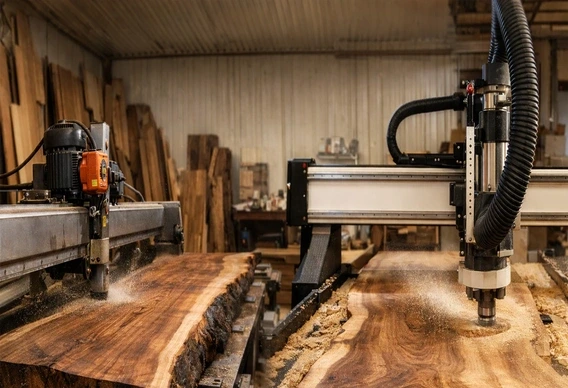
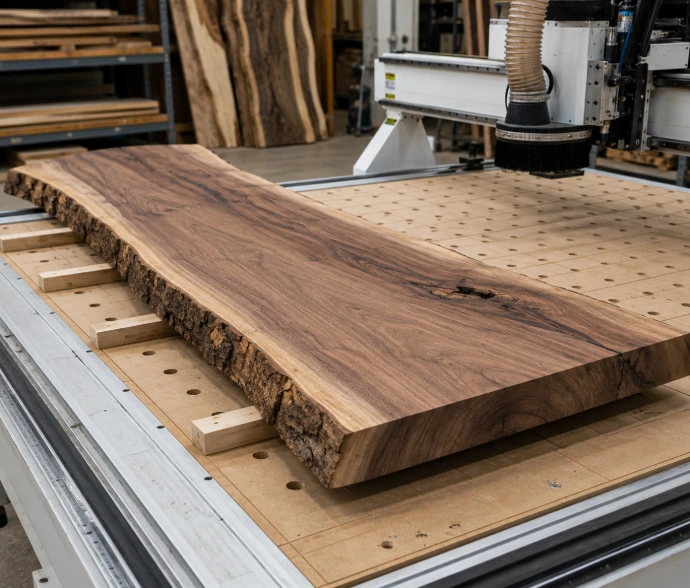
CNC wood slab milling
Wide slabs and glued hardwood panels may contain bow, twist, cupping or uneven thickness that makes joinery, sanding and installation more difficult.
CNC surfacing removes material using a controlled tool path to establish a flatter reference face. The opposite face can then be machined toward a more consistent thickness.
Preserve natural live-edge character while machining the working faces.
Prepare the slab for sanding, finishing, hardware installation and assembly.
Coordinate surfacing, trimming, profiling and hardware preparation within one project.
Wood slab milling services
The exact scope depends on slab condition, available thickness, geometry, final dimensions and intended use.
Remove high areas to correct many forms of bow, twist and cupping while establishing a workable reference face.
Machine the opposing face toward a more consistent final thickness.
Square or trim selected ends and edges to approved dimensions where geometry allows.
Add compatible chamfers, radii or project-specific CNC edge profiles.
Machine selected channels, pockets or cavities for suitable river-table projects.
Add mounting holes, inserts, recesses and leg-plate pockets from approved dimensions.
Review removable hardwood countertops and butcher-block panels for flattening and correction.
Surface multiple pieces toward coordinated thicknesses for paired or grouped projects.
Discuss sanding or finishing separately when the project requires more than CNC machining.
Slab eligibility and preparation
Photos, dimensions and drying information help determine feasibility and how much material may need to be removed.
CNC slab-machining guide
| Operation | Primary purpose | What to provide | What happens next |
|---|---|---|---|
| Face flattening | Establish a flatter first reference surface | Slab dimensions, face photos and condition details | The opposite face may then be surfaced |
| Thickness surfacing | Create more parallel faces and approach final thickness | Required minimum or target thickness | Slab normally proceeds to sanding and finishing |
| Final trimming | Establish approved length, width or square edges | Final dimensions and preservation requirements | Edges may receive sanding or profiling |
| Edge profiling | Add a chamfer, radius or compatible contour | Profile dimensions or an approved reference | Profiled surfaces usually require finish sanding |
| Hardware machining | Prepare holes, recesses and mounting locations | Hardware drawings, dimensions or physical hardware | Hardware can be test-fitted before finishing |
| Epoxy preparation | Create or clean a suitable channel or pocket | Channel geometry, depth and epoxy layout | Epoxy work and final leveling are coordinated separately |
Quote and scheduling requirements
| Slab type | Live-edge slab, glued panel, butcher block, countertop or table top |
|---|---|
| Current size | Maximum length, width and thickness measured at several locations |
| Condition | Bow, twist, cupping, cracks, voids, bark, epoxy, finish or visible damage |
| Wood condition | Drying history, acclimation and available moisture information |
| Desired result | Flatness goal, final thickness, finished dimensions and live-edge requirements |
| Additional machining | Trimming, profiles, holes, pockets, inserts, leg plates or epoxy channels |
| Handling | Approximate weight, delivery method and assistance requirements |
| Schedule | Required completion or installation date |
Recent slab-machining work
Use existing project photographs to demonstrate flattening, surfacing, trimming, hardware preparation and finished applications.
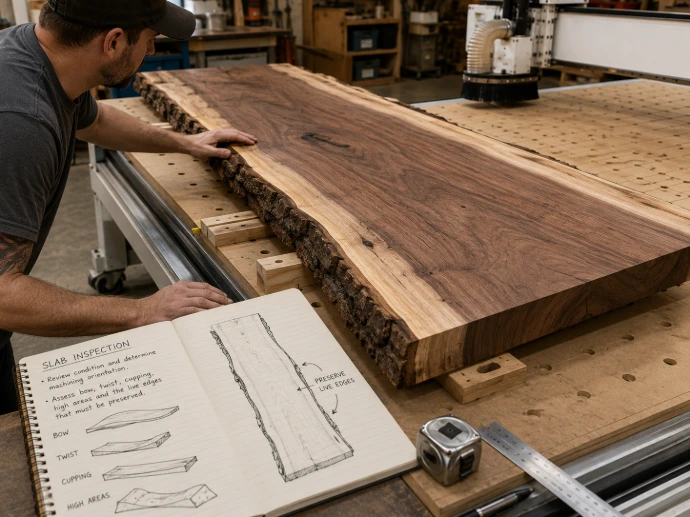
Assess bow, twist, cupping, high areas and the live edges that must be preserved.
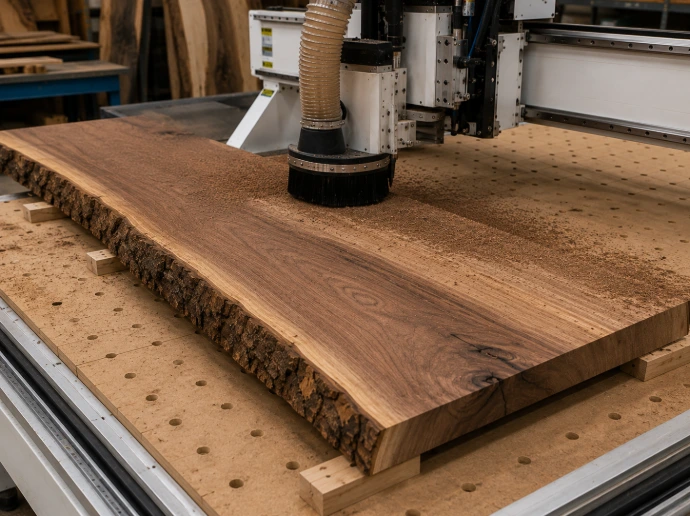
Remove high areas using controlled CNC passes before machining the opposing face.
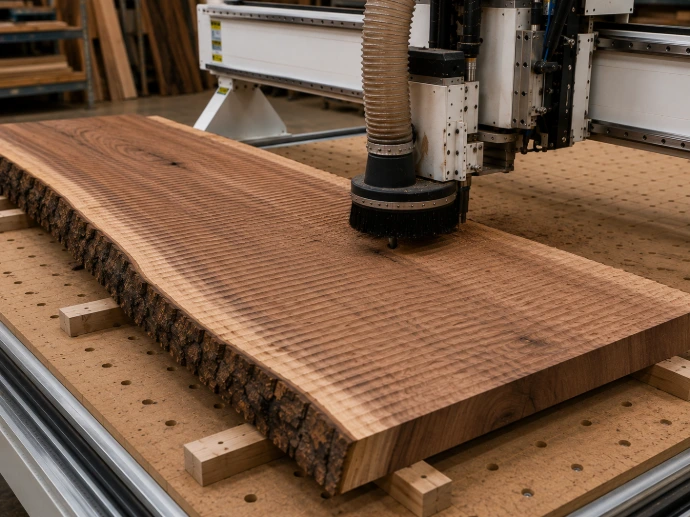
Prepare the workpiece for subsequent sanding, finishing and assembly.
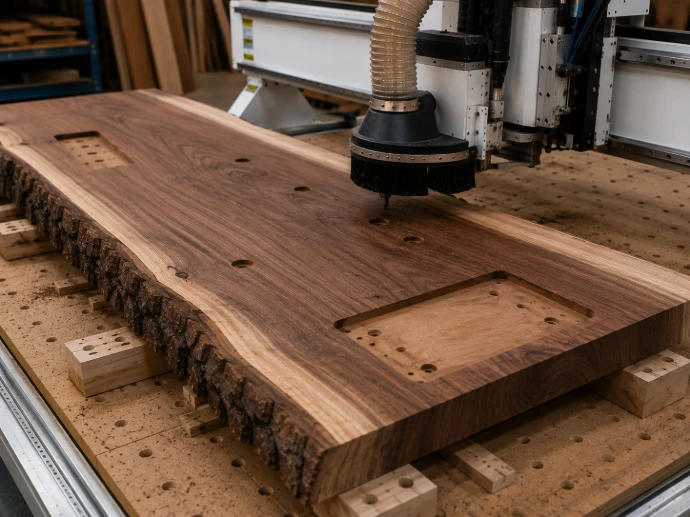
Machine underside features using approved hardware dimensions or supplied components.
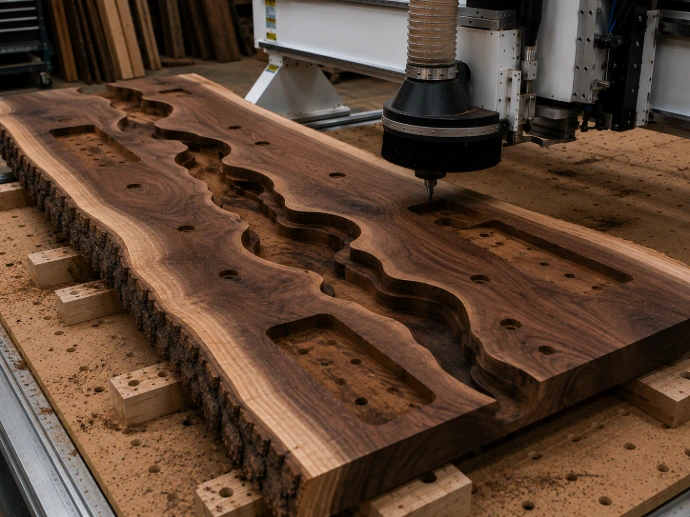
Prepare suitable geometry for approved epoxy or decorative-inlay projects.
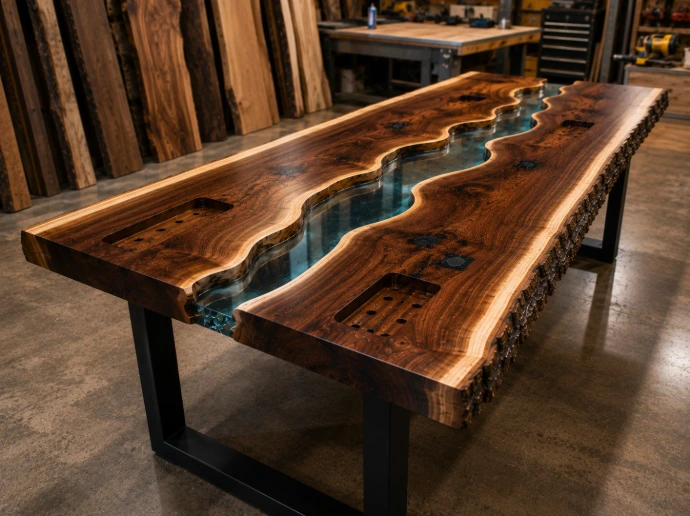
Continue with sanding, finishing, hardware and assembly after CNC machining is complete.
Common applications
Flatten and thickness slabs before sanding, finishing and attaching the table base.
Prepare wide surfaces and coordinate hardware or cable access.
Surface removable countertops and glued panels before installation.
Prepare wood surfaces for hospitality and commercial environments.
Machine customer-supplied feature slabs for offices, hospitality and retail interiors.
Review slabs for channel preparation, leveling and selected post-pour surfacing.
Coordinate thickness and dimensions across matching pieces.
Prepare office, studio or workshop tops for bases and hardware.
Surface custom slabs for walls, counters, displays and specialty interiors.
Wood slab surfacing process
Submit photos, dimensions, condition and desired result.
Review capacity, operations, handling and schedule.
Bring the approved workpiece to the Powell facility.
Secure the slab and review orientation and high areas.
Complete the approved surfacing and CNC operations.
Continue with sanding, finishing and assembly.
Knoxville-area slab surfacing
865FabLab
7661 Clinton Hwy
Powell, TN 37849
Submit photos and dimensions before transporting large or heavy workpieces.
Contact the ShopCustomers outside these areas may contact the shop to discuss project logistics and transportation.
Have a slab ready for review?
Include current thickness, maximum width and length, visible warp or cracks, drying information and additional CNC operations.
Wood slab milling FAQs
Feasibility depends on size, condition, moisture, thickness, embedded material and requested operations.
Discuss Your SlabContact 865FabLab
Send slab photographs, dimensions, condition details, desired thickness and additional CNC operations for review.